
Culinary
Aug. 30th, 2026 06:54 pm![[personal profile]](https://www.dreamwidth.org/img/silk/identity/user.png) oursin
oursinThis week's bread: a very simple loaf which I meant to be just Marriage's Light Spelt flour but there wasn't quite enough so it turned out about 5:1 that and Strong Brown, with a splash of Roasted Pumpkin Seed Oil, v nice.
Friday night supper: penne with a sauce of chopped chorizo and salami and the rest of the jar of sundried tomatoes in oil with garlic and oregano from the other week, whizzed in the blender, rather good.
No Saturday breakfast rolls as I had inadvertently ordered a double lot of croissants.
Today's lunch: panfried seabream fillets with samphire sauce, served with sticky rice with dried lime leaves, baby vine tomatoes roasted in olive oil with salt and basil, and sweet and sour okra + chopped Romano pepper and baby leeks (the okra was perhaps just a little bit past it).
With this we had, as per tradition, Bollinger La Grande Annee (2015), for our 42nd anniversary of living here together.
History
Aug. 30th, 2026 12:26 pmysabetwordsmithHundreds of geometric earthworks were recently found in the southwestern Amazon, evidence that a monument-building, precolonial civilization was so much larger than previously thought. The scale of this hidden world of massive earthen construction projects only began to truly be understood this decade, but a recent aerial survey using laser radar has dramatically increased the footprint of this civilization. It may indeed be larger than anything yet known in the region, with the total body of evidence showing a greater concentration of these structures in just 3% of the Amazon than in the other 97%.
If you want to build monuments that last as long as possible, choose earthworks. Dirt tends to stay where it's put over a long time.

Birdfeeding
Aug. 30th, 2026 12:20 pmysabetwordsmithI fed the birds. I've seen a few sparrows and house finches.
I put out water for the birds.
EDIT 8/30/26 -- I did a bit of work around the patio.
EDIT 8/30/26 -- I did more work around the patio.
EDIT 8/30/26 -- I watered the new picnic table garden.
.
Roman Space Telescope Launches Tomorrow
Aug. 29th, 2026 12:46 pm![[syndicated profile]](https://www.dreamwidth.org/img/silk/identity/feed.png) centauri_dreams_feed
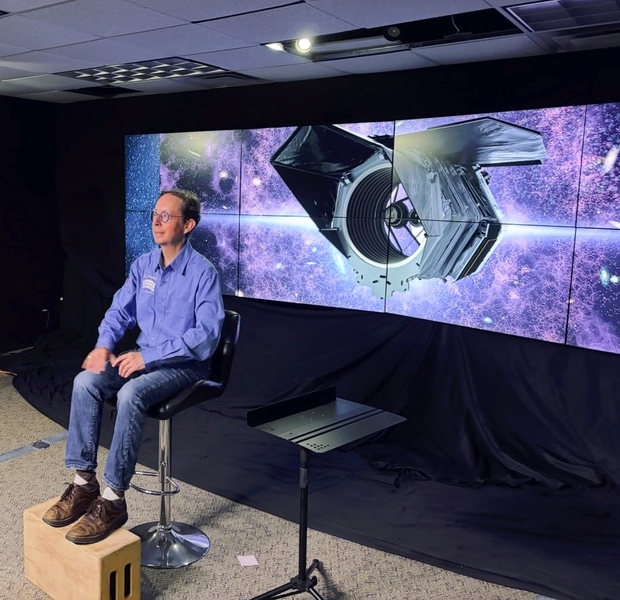
centauri_dreams_feedWe’ll have a lot to talk about when observations from the Nancy Grace Roman Space Telescope start coming in. But first we’ve got to get it out to its halo orbit around the L2 Sun-Earth Lagrange point. With the Sun, Earth and Moon permanently blocked out, the seeing should be good from this vantage some 1.5 million kilometers out. Just now I’ve had a note from Jim Benford reminding me that launch is currently scheduled for tomorrow, August 30, at 0726 ET (1126 UTC). The additional good news is that Jim’s son Dominic will be one of two hosts of the live coverage from NASA. I remember meeting Dominic some years back at Goddard Space Flight Center, where I had the chance to see the JWST telescope being prepared to go through its vibration testing.
Dominic has spent more than a decade working on the Roman telescope, so the honor of working the NASA live coverage is well deserved. The photo below shows him during preparations for the Sunday coverage, which starts at 0620 ET (1020 UTC). You can tune in on Facebook, Instagram, Twitch, X, Discovery+, Amazon Prime, YouTube, or NASA+ (see https://www.nasa.gov/live/ for links and updates).
And as Jim reminds us: “As with any launch, timing can change because of weather or other conditions, so check NASA for the latest schedule. Fingers crossed!”

Gideon had a 6th birthday party
Aug. 30th, 2026 05:18 pmandrewduckerToday we had a kids birthday party in our house for the first time since Covid. 10 of them, mostly 5-6 year-olds. Every previous time we held it somewhere else - a soft play, a climbing centre, a kids gym - somewhere where we could turn up and let the kids run riot for an hour, then give them food for 45 minutes before the staff ushered us out and hosed the place down for the next party.
But Gideon decided, about 6 months ago, that he really wanted a movie-watching party. In pyjamas. This was because a friend of Sophia's had dome that at a nearby multiplex, and he thought it was the coolest idea ever.
I stressed about this for a bit, looked up the exorbitant cost, stressed about that for a bit (particularly because you're booking a whole screen, so it's quite expensive when your child only has about 8 people they want to invite), and then happened to mention to Gideon that we'd have to watch whatever the cinema was able to find for us. And he said "Oh, I only want to watch the Mario Galaxy movie." - which made things very simple, because we have a living room with a 65" TV and space for 10 kids at home.
Frustratingly, I reminded him of all of this about three weeks ago, and got a response along the lines of "Why would I want that? I never said anything of the kind. You must have been imagining things father, what an imagination you have."
So I let everyone else know that some people could watch the movie in pyjamas, but it wasn't mandatory. And then we prepped for the party yesterday - including not having a big cake (because Gideon doesn't like cake) - substituting with a bright pink doughnut for him to have his candle in and Minecraft cup cakes for all of the other kids.
Everyone turned up just fine today, and they seem to have had a lovely time - there was half an hour of frenzied running and screaming around the house to start with, followed by 80% of them watching the first 50 minutes of the movie, and then they split up around the house in small groups, some of them watching the movie, some of them playing with toys, and some of them sharing the three Minecraft-capable tablets/accounts that we have to have 5 minutes each playing together. The adults switched rooms depending on which room the children were occupying, and I actually got to have conversations with some of them - a first for most of them, as I haven't really met Gideon's friends' parents much before.
Gideon noped out around the two-hour mark, retreating to his own tablet. Everyone else lasted another half an hour, and then parents spirited their kids home, Gideon and Sophia enjoyed opening all the presents up, and the family have dispersed to recover individually around the house.
Overall, it was less stressful than I worried, I haven't had to clear any cake off the ceiling, and the most damage was from one of the kids working out how to change the Minecraft world to Creative, and then the others taking the opportunity to totally overbuild the starting area with various high-level nonsense. So, overall, a pretty successful small-child birthday.
12 or 20 (second series) questions with Jay Quint
Aug. 30th, 2026 08:31 amrob_mclennan_feed
1 - How did your first book change your life? How does your most recent work compare to your previous? How does it feel different?
My book was only recently published, so life hasn’t changed much—and who knows if it will? I’m working on it though ... Once the book was accepted for publication, I did, however, find I was able to get my foot into doors that would’ve otherwise been much harder to crack open. I’m not one of those writers who built their career brick by brick, publishing articles, or essays, in smaller newspapers and presses over the years. I also steered clear of academia, and even avoided literary scenes, so I didn’t have any contacts to help me get published. Being able to tell more established writers than yourself that you’ve placed your book with a publisher, gives a degree of legitimization that most other unknowns don’t have; It was how I was able to get so many people to read my book, and write blurbs for its back cover. Of course, it also had something to do with interesting aspects of the book itself. The gatekeeping of the publishing industry is off-putting to those who aren’t on the inside, but the reality is that all industries are structures that end up producing similar issues. Even great writers often need to play the game to get on the inside.
2 - How did you come to non-fiction first, as opposed to, say, fiction or poetry?
Writing starts with reading for me, and it was modernist novels and philosophy that really engaged me from the very start of my career as a serious reader (Yes, reading was essentially my career—though unpaid and unsung—for nearly 6 years.) I spent time toying with the idea of writing something Kafkaesque transposed on contemporary city-apartment life, a blend of fiction and nonfiction. But it was really with criticism that I found the sweet spot matching my own sensibilities. I became passionate about Walter Benjamin, and Susan Sontag, and I ended up anchoring myself at their crossroads (pre-war and post-war; Europe and America; modernism and post-modernism; creative and critical intellectualism). I love good prose and a degree of creativity in nonfiction. My favourite thing is to recover overlooked and forgotten tidbits that offer historical insights into the present, which is very much part of Walter Benjamin’s influence and legacy. I’m also inspired by the personal playfulness of the “new-journalism” writings of Mailer, Didion, and Tom Wolfe, on one hand, and the more dense politically-historical analysis of figures like Arendt, on the other.
3 - How long does it take to start any particular writing project? Does your writing initially come quickly, or is it a slow process? Do first drafts appear looking close to their final shape, or does your work come out of copious notes?
As you may be able to tell already, relatively simple questions often require me to take a step backward before I can go forward. To answer this question, I’m suspicious about the value of writing today. I don’t believe in extolling all writers as necessary, all writing as worthwhile, and all expression as inherently good. In the tradition of Critical Theory and cultural criticism, the negative has value in life. Hegel had put it simply: all perception involves negation. Thinking is always dialectical. And isn’t it also true, generally speaking, that there’s an inverse relationship between the quality and quantity of all types of output, including writing? I think there’s already far too much of it today—it can be argued that there was already far too much if it 150 years ago—and that the bulk of it isn’t very good. How much of the “content” is just plain bad? How much of it is unoriginal rubbish masquerading as something brilliant, and new? Whole industries exist with an interest in telling us how wonderful new writing is, but even most of those at the top of the “literary” and “intellectual” worlds are shadows, I think, of the older generations of writers who inspired them. Naturally, I get lots of pushback when I say these things because it offends the personal sense of value of writers, and readers, alike—and because I don’t let myself weasel out of my own judgements, the question for me becomes, how can I, as someone who wants to write (and wants to say things that have already been said countless times before, really), do so without being entirely hypocritical? Why do I even want to write? Is there a new, creative angle I can use to approach cultural history, to say something that really demands consideration? The long path to what would eventually become Village Dreams was philosophical and slow-going because it began with these overriding concerns about the act of writing itself. I grappled with them for a long time before I was even able to put pen to paper. Ultimately, I did arrive at a solution—or a workaround, let’s call it. Once I had the idea, things went fairly smoothly. I did about fifteen drafts in the end, but that’s because I was crafting my own unique form that required the balancing various creative and intellectual considerations. My next book may follow an entirely different process, however. I might even be inspired to write something that isn’t so serious, and doesn’t need to justify itself.
4 - Where does a work of prose usually begin for you? Are you an author of short pieces that end up combining into a larger project, or are you working on a "book" from the very beginning?
My sensibility is attuned to longer forms because I like clustering thoughts of various writer-thinkers together and spinning off onto interesting tangents. Essays appeal to me though, but getting them published typically requires contacts that I haven’t put in the time to cultivate. I would love to write essays knowing they’d be published in a quality newspaper, or magazine, as soon as I was ready to release them to the world— but that’s a rare position to be in as a writer. I also have some difficulty knowing where a subject should begin and end since everything’s connected in my mind. There’s always another link, I think, that can advance the discourse.
5 - Are public readings part of or counter to your creative process? Are you the sort of writer who enjoys doing readings?
I had my first reading last month in Toronto. The event was put together by my publisher, and it included the six or so other writers they’d published this season. I’ve always hated public speaking, but I was excited to get a firsthand reaction to the section I planned on reading. And I really ended up getting the most enthusiastic reaction. The audience really felt what I wanted them to feel. It was quite powerful, to be honest. Having said that, I wouldn’t organize my own readings. The performative aspect of these events feels unnatural to me. It may just be that I don’t consider myself important enough for people to come see, and that I myself have no interest in going to see other writers reading from their own books. The idea of having discussions, or debates, is a bit more interesting to me than a reading.
6 - Do you have any theoretical concerns behind your writing? What kinds of questions are you trying to answer with your work? What do you even think the current questions are?
As I mentioned, I’m concerned about the value of all writing. It’s more than the absurd quantity and declining quality of output; I’m haunted by the idea that everything has been said already, and that we bury older writing that’s valuable under the endless landslide of new … crap. Applying old thoughts to supposedly new situations doesn’t cut it for me. A lot of people don’t understand this because they think so much today is new. When a person cultivates a more historical view that gives a broader, sort of overhead, vantage point from which to survey the entire field of action, things look quite different. Those who are caught up in the action on the ground can’t perceive the situation with the same understanding. This may sound pretentious, but it’s really a basic metaphor. I find it funny that, in my experience, many people who agree with the general claim that understanding the past is important for understanding the present—and most people agree with this, I think—will disagree about the worth of historical insights when applied in particular instances, and when it goes beyond the level—and conclusions—they’re comfortable with. Kierkegaard spoke of the proscribed level of knowledge that mass society refused to let any individuals surpass without penalty. The proliferation of mass media clearly had a lot to do with this, as religion did before it. It’s the difference between people who are consumed by presentness, by the news media, entertainment, and technology, versus those who’ve stepped outside of the spectacle to see how forces interacted to get us to this point, and to understand the cyclical nature of life amid all the supposed “newness.” Technology may deliver new products, but understanding the place of technology itself within the whole, reveals as much.
7 – What do you see the current role of the writer being in larger culture? Do they even have one? What do you think the role of the writer should be?
It’s not easy for people to resist flowing along within the accelerated rhythm of the world we live in. Everyone needs to make a living, to sell themselves, or some product, and this requires adapting to life as it is (and I think much of historically leftist critique of capitalism is right when it comes to points like this one). I’m an ardent believer that writers and artists are the ones who have the vision, courage, strength—and often the resources—to stand alone, and maintain a certain distance from the events of the day, with all of its little excitements. A big part of it is about being able to slow down, I think, and learning to think independently, which involves reading broadly, and across ideological lines. Writers—and here we can draw a distinction between those whose aim is to write bestsellers catering to mass tastes, and those who want to craft something that’s essentially different, something fuller, whole, suffused with the real complexities of life, rather than simplistic narratives. The latter kind of writer, who deserves the name “artist,” should have just a few toes in the present; they should see what’s happening in the world, while also embracing a degree of remove that allows them to perceive life more “objectively”—and let’s leave aside the question of objectivity here. In the past, this distance was referred to in a number of other ways. Proust often refers to the “disinterested” perspective in relation to the arts. The word shouldn’t be misinterpreted, though: “disinterested” means cultivating an impartial point of view, rather than coming at art with pre-existing biases that are based on self-interest. It’s not about limiting one’s sense of the world—rather the opposite, in a way. It’s about being more open, receptive, and understanding. I realize that this opinion—like most of my opinions—isn’t the popular one today. Progressives usually demand a more socially-engaged art, and they assert that anything that doesn’t call for full-throttle self-expression, and unbridled emotional reaction, is dispassionate, anti-social, and conservative. But the hyper-passionate approach puts the narrative, and conclusion, ahead of itself, and is therefore biased, and self-interested in its desire for affirmation. Being “disinterested” is more subtle. This is a version of the old debate about art for art’s sake, versus an engaged art, which returned in the ‘60s (especially in France), with the call for art to be in the streets. I’m sure many people who are reading my answer here won’t be convinced, so, characteristically, I’ll end by offering a long quote that I think is worth considering. This, from Italo Calvino, an essay called Why Read the Classics (1981): “‘Why read the classics rather than concentrate on books that enable us to understand our times more deeply?’ or ‘Where shall we find the time and peace of mind to read the classics, overwhelmed as we are by the avalanche of current events?’ We can of course, imagine some blessed soul who devotes his reading time exclusively to Lucretius, Lucian, Montaigne … Ruskin, Proust, and Valéry … To keep up such a diet without any contamination, this blessed soul would have to abstain from reading the newspapers, and never be tempted by the latest novel, or sociological investigation. But we have to see how far such rigor would be either justifying or profitable. The latest news may well be banal or mortifying, but it nonetheless remains a point at which to stand and look both backward and forward. To be able to read the classics you have to know “from where” you are reading them; otherwise both the book and the reader will be lost in a timeless cloud. This, then, is the reason why the greatest ‘yield’ from reading the classics will be obtained by someone who knows how to alternate them with the proper dose of current affairs. And this does not imply a state of unperturbable inner calm. It can also be the fruit of nervous impatience, of a huffing-and-puffing discontent of mind. Maybe the ideal thing would be to hearken to current events as we do to the din outside the window that informs us about traffic jams and sudden changes of weather, while we listen to the voice of the classics sounding clear and articulate inside the room. But it is already a lot for most people if the presence of the classics is perceived as a distant rumble far outside a room that is swamped by the trivia of the moment, as by a television on full blast.”
8 - Do you find the process of working with an outside editor difficult or essential (or both)?
I wanted a lot more input from my editor when it came to Village Dreams. The book is unconventional in many respects, it bounces with stream-of-consciousness ideas, and digressions. When it came to the editing process, I expected lively discussions about what to include and what to cut, about the book’s real purpose, and meaning. But my editor approved everything so easily, which left me without the bouncing board I really wanted at that point. I realized that I’d have to go back and self-edit the manuscript. To do so effectively also meant understanding it so fully that I could grab it by the horns. Most readers probably think this is something most writers automatically do, but I think it’s rarely the case. Writers and artists often create without knowing all of the keys to their own work. In the 19th century, the task of decoding the innerworkings of a work of art became the territory of the critic, more than the creators themselves. Understanding the ins and outs of one’s own writing, tightening it properly, typically requires a few more drafts than one has the mental energy for (It makes me think there may be something to the stereotype of the pretentious painter who refuses to explain their own work.) It’s a daunting prospect to think about digging back into your own writing when your head is already so saturated with the content, and you believed you were nearly done with it. It’s even difficult to step away from it when you know it’s there waiting for you, and that you’re going to have to figure out how to give it a final shape, and polish it off, as best as you can possibly do. In my experience, these extra pushes are worth the dissonance they cause. Again, it’s usually one step back, two forward, for me. Putting in those extra few months of work led to a final version of Village Dreams that really exceeded my own vision for it. A good editor ca be invaluable, though. I have a writer friend who always came away from meetings with her editor feeling that the editor’s advice was wrong, and that she was being pushed too far. But after a few days sitting with the advice, my friend always came to see her editor’s point. This is just one example, of course. There isn’t a single model for these relationships, which are sometimes complex, and touchy. Listening to one another and having mutual respect is crucial, but it’s also true that the visions of a writer and editor can diverge too much, in which case it’s best for them to part ways.
9 - What is the best piece of advice you've heard (not necessarily given to you directly)?
I’ve never received a good piece of advice. I also think that advice, like wisdom, can point people in one direction just as easily as the opposite. For example, advice could be, “You have to take the leap—no risk, no reward! Quit your job and start writing if that’s what’s really in your heart!” Alternatively, it can be, “Caution—slow and steady wins the race! Everything comes in its own time.” Advice should always be contingent on the particular set of circumstances and character of the individual who asks for it. One of my pet peeves is when people couch their own ideas and experiences in universal terms—especially when they do so with pseudo-intellectual, or pseudo-spiritual, pretenses. Roland Barthes has a hilarious essay in his book Mythologies about how the masses who make up bourgeois-liberal society try to cast everyone and everything in their own mold to the extent that they imagine extraterrestrials (which became a popular subject in the ‘50s) as having bourgeois-humanist mindsets just like themselves.
10 - What kind of writing routine do you tend to keep, or do you even have one? How does a typical day (for you) begin?
I like to do a couple of 3-4-hour sessions each day because my brain gives out after that length of time. I’ll wake up and walk to my favourite café to read, or write. Then I’ll usually have a workout because I need a break, and switching from the mental to the physical is healthy for both dimensions, I think. It’s difficult to let go when you’re deep in the creative process, but you have to try. In the afternoon or evening, I’ll do a few more hours of reading, or writing, at home. I might also watch a film, often something slightly philosophical, or something that offers some interesting historical context related to whatever I’m writing, or researching. I love incorporating film into my writing.
11 - When your writing gets stalled, where do you turn or return for (for lack of a better word) inspiration?
I always go back to books, especially since my writing is mainly about cultural history. Sometimes intense readers need breaks from reading, though. Even Sontag, who was addicted to reading, needed to clear her mind of books at times. Sometimes our brains need a reset, and it’s always a good idea to try looking somewhere new for inspiration. I’ve gotten back into watching sports as an outlet—hockey and tennis, in particular—though I can get into the playoffs of most sports.
12 - What fragrance reminds you of home?
My first thought is whether “home” here is really just a stand in for childhood? or do you mean where I live now? I prefer the former because it triggers my Proustian sensibilities, yet I don’t really have an answer other than some vague thoughts about warm grass in the summer, and a faint sense of perfumes worn by my mom when I was a kid. I wouldn’t be able to describe the scent though because I can hardly even evoke it in my mind. I’d have to smell it. Admittedly, this answer is somewhat of a poetic cliché, but it’s what comes to my mind. I once had a friend who told me that the sound of a vacuum always made him tired because his mother would vacuum the house when he was put down for his naps as a child. I thought that was interesting.
13 - David W. McFadden once said that books come from books, but are there any other forms that influence your work, whether nature, music, science or visual art?
I agree. Books do come from books, which is part of the reason I find most things so regressive today. Books from books from books that are third-rate knockoffs of the original work. But there’s also film, for me. It was reading Sontag’s essays on New Wave cinema of the ‘60s and ‘70s (Godard, Bergman, Fassbinder, Varda, etc.) that popularized the idea that film could be part of intellectual discourse. Of course, the New Wave contained this idea in-itself because it was heavily imbued with cultural-political and artistic commentary (re. Cahiers du Cinéma), and experiments with the medium itself. The New Wave often tried to overcome the medium, which is something I’m both interested, and critical of.
14 - What other writers or writings are important for your work, or simply your life outside of your work?
Sontag’s collection of essays in On Photography are a focal point for me. I think the critiques she gave in the early ‘70s have only grown in relevance since images proliferate and dominate contemporary life more and more. Her own work picked up threads from Walter Benjamin, who’s also a major influence on my writing. These two critics are quite mainstream within intellectual milieus, but I think I’ve dug deeper and understand them and their thought more than most professional academics who like to talk about them. I’m most concerned about how their thought is being distorted to fit evolving narratives. More than anything, I want to reassert the critical elements of their thought that’s being purposefully ignored. This is also happening with other writers and thinkers who influence me: Camus, Arendt, Adorno, to name a few. The work of everyone I’ve mentioned affects my perspective on nearly everything. I don’t compartmentalize my writing from the rest of my life because I’m always concerned with the same thing: revealing contradictions.
15 - What would you like to do that you haven't yet done?
I’ve prioritized travel over a settled life of comfort for over a decade now. I’ve spent a lot of time in London, and whenever I’m there, I get excited about the idea of setting up shop in Chelsea for a year or so to write a novel.
16 - If you could pick any other occupation to attempt, what would it be? Or, alternately, what do you think you would have ended up doing had you not been a writer?
I did my undergraduate degree in accounting—a field that couldn’t be more opposed to my natural inclination. I was a very perplexed, disoriented kid. I wasn’t really encouraged to explore my creative side, and the “do-whatever-makes-you-happy” ethos wasn’t something I grew up with. The professions were the most sensible option given my lack of direction. In my early teens, I developed an interest in old film (Hitchcock in particular), which was part of an escape from real life, and my sexual confusion, I think. I remember wanting to study film, to become a director, or maybe a screenwriter. But now that I’ve become a writer, I find myself drawn to less intellectual work. I like the idea of making things with my hands, like a carpenter, a furniture designer, or perhaps something to do with plants, like a gardener, or landscape designer. I think it’s common for writers—existential ones in particular—to reach a point where they begin to fetishize more manual labour. Wittgenstein comes to mind.
17 - What made you write, as opposed to doing something else?
I’ve always enjoyed writing, but I didn’t pursue it until my mid-twenties. I have a very active imagination, but it’s tied to reality. I don’t have the capacity for purely inventive storytelling. I needed to have more real-life learning experiences to give content and form to my passions. I don’t believe people are really destined to do one thing or another, to be honest. It’s like when people talk about meeting their soulmate; I don’t buy the idea that one person is meant for us. It’s yet another narrative that makes people feel comfortable, and gives their lives meaning. In reality, I think everything we end up doing is a combination of nature and nurture, chance and choice. I could’ve easily ended up as an accountant, or hotel manager—things I was at one time on track to become. But I’m glad I became a writer because I do think it suits my nature more—which isn’t quite the same thing as saying “I was meant to be a writer.”
18 - What was the last great book you read? What was the last great film?
I’m rereading Proust, which is more than a “great” book. Swann’s Way, the first section, is a masterpiece—and I wouldn’t use such a word lightly. Otherwise, I’d say The Man Without Qualities by Robert Musil. It’s 1300 pages of the smoothest, cleverest, and yet unaffected writing I’ve ever read. I was shocked by it. As for film, I recently rewatched the German film, The Lives Of Others, which I think is one of the best films of this century so far. I also saw the Norwegian film Sex, part of the “Sex Dreams Love” trilogy by Dag Johan Haugerud. It’s complex, funny, psychologically revealing. Like many Scandinavian films—Joachim Trier’s Oslo trilogy, for instance—there’s a Bergmanesque quality in the characters’ existentialism and their chattiness. A lot of interesting thoughts are revealed in conversations that try to resolve strange situations. Being selective about the contemporary books and films I engage with is also a control mechanism, or an ecology, as Sontag put it. It’s a way of giving myself an artificial sense of having some control over the overwhelming tide of output.
19 - What are you currently working on?
Now that Village Dreams has been published, I’ve had
to make the transition to the “publicity” phase. It wasn’t easy for me to make
the switch, but now that I’ve done it, I’m excited about chances to discuss and
debate the ideas I put into the book. After all, that’s what I really wanted
from the start. My drive was more about ideas, than about storytelling, or writing
as a craft. I’ll likely spend the next six months or so doing my best to keep
that ball rolling. I’m not good at juggling multiple projects, so I can’t
really think too much about what comes next. (Buy my book! Thanks.)
12 or 20 (second series) questions;
The Victorian Chaise-Longue By Marghanita Laski
Aug. 30th, 2026 08:10 amjames_davis_nicoll
Melanie Langdon--or at least her mind--is transported from post-war England to the filthy, barbaric England of a century before.
The Victorian Chaise-Longue By Marghanita Laski
This El Niño Will Be Unlike Any in the Past Eight Decades
Aug. 30th, 2026 07:00 amtheatlantic_science_feedIn the middle of the Pacific Ocean, along the equator, scientists have drawn a box. It’s a big box, two-thirds the size of China, yet hardly anyone lives inside it. This rectangular swath of open ocean is monitored by satellites and a network of moored buoys that measure minute changes in the temperature of the water, with an eye toward anomalies. Every few years or so, driven by changing winds and currents, the water temperature in this part of the ocean starts to rise; even a half degree Celsius above normal over months warrants a designation that an El Niño phase has begun. That’s enough warming to unleash floods and fires, drought and famine, around the world. The box is called Niño 3.4. Right now, it’s hot in the box.
“Like a baby pool,” Kristina Tietjen, who spent most of August scuba diving in the middle of this mass of abnormally warm water, told me. Tietjen has been coming to the world’s largest atoll, Kiritimati, for more than a decade to study its coral reefs. She usually dives in a medium-weight wetsuit; this trip, her team needed only rash guards. It is still early in this El Niño cycle—which is likely to be the strongest ever recorded—but the waters around Kiritimati have already been 3 to 4 degrees Celsius above normal.
Tietjen’s time on Kiritimati (pronounced like Christmas) has allowed her to watch, in brutal detail, what these repeated warm-water cycles, playing out in a steadily warming ocean, mean for the great tropical coral reefs here, which were once near pristine. During her first El Niño, in 2015–16, 90 percent of Kiritimati’s coral reef died. Years of slow, partial recovery followed. This month, Tietjen and her colleagues, part of the Canadian scientist Julia Baum’s lab at the University of Victoria, discovered that nearly half of the island’s remaining corals had already bleached—a prelude, if warming persists, to death. When Tietjen comes back, she may well be swimming over a graveyard.
Most of the world experiences El Niño’s ripple effects as the heat building up in the equatorial Pacific radiates into the atmosphere and around the globe. This means great gouts of rain in supercharged storms in some places; in other areas, crop-killing dry spells that can extend for months. Along the Pacific Coast of South America, torrential rains and landslides have forced the temporary closure of a main route to Machu Picchu, in Peru; deadly floods have swept through arid regions of northern Chile. Countries such as India and Ethiopia are enduring some of their driest summers on record. El Niños tend to mean more rainfall across the southern United States and drier stretches across a band in the North. Strong El Niños can mean record-breaking heat, and this one is shaping up to be unlike any catalogued in the past eight decades. A 2-degree-Celsius increase in the Niño 3.4 box typically earns the title of “Super El Niño”; we’re already past that threshold, and experts project that the warming could peak at roughly twice as high. “We are now pretty certain this will be an exceptional event,” Malte Stuecker, the director of the International Pacific Research Center at the University of Hawaii at Manoa, told me.
Part of the reason Stuecker expects this warmth to keep building is that the buoys along the equator can detect water temperatures well below the surface. Down more than 100 meters, an enormous mass of warm water has built up and will rise to the surface in the months ahead. The amount of heat brewing in the ocean has produced one of those graphs in which the current year departs drastically from past trend lines, wriggling up erratically into unfamiliar territory.
Although scientists continue to debate the extent to which climate change makes El Niño cycles more frequent or intense, they agree that these cycles are occurring in an ocean that is warmer than it was. Last Saturday, the daily global average sea-surface temperature reached 21.1 degrees Celsius (70 degrees Fahrenheit), its highest level on record, according to Europe’s Copernicus Climate Change Service. Even if El Niño cycles are not changing at all, as they spiral around that ascending baseline, the temperature peaks they hit keep getting higher, causing repeated blows to marine life and disrupting ecosystems in ways that may be irrevocable.
Carlos Zavalaga, the director of the seabird lab at the Universidad Cientifica del Sur, in Lima, began to comprehend the magnitude of this year’s warming in mid-June, when he visited Macabi and Guanape Norte, two islands off the northern coast of Peru. He’d been hearing from colleagues about dead birds washing up by the hundreds on the coasts of Peru and Ecuador. He’s seen the news stories about flocks of hungry Peruvian pelicans swarming the fish markets in port cities looking for food. On the two islands, which just last year were thronged with pelicans, Inca terns, and Humboldt penguins, Zavalaga found empty nests, some with eggs and starving chicks. “They were abandoned islands,” he told me.
These seabirds feed on schools of anchovies swept up in the Humboldt current, the cold, nutrient-rich upwelling waters that create bountiful fisheries off South America’s Pacific Coast. During El Niño years, that current gets displaced by warmer waters pushing east across the ocean, and these great schools of feeder fish can vanish from the coasts. The decline has been severe enough that Peru this month shut down an anchovy fishery that is a key economic engine for the country, with much of the year’s quota unfilled. Long before satellite monitoring, Peruvian fishermen noticed these cycles of warmer waters and dwindling fish stocks; they named the phenomenon, which peaked around Christmas, after the Christ child. References to El Niño in Peru’s scientific literature date back to the 19th century.
In his three decades studying seabirds, Zavalaga has witnessed die-offs before. But it is the rapid-fire nature of these blows and the severity of the disruptions that make him so concerned. Just three years ago—the same year avian flu killed more than 500,000 seabirds—another El Niño slammed into the coast of Peru. The birds that had made a tenuous recovery since then now face the prospect of another die-off. “It’s like a boxing match: You have a first knockout, you try to recover quickly, and then you have a second knockout,” he said. “I cannot imagine what will be the scenario by the end of this year.” He doubted that the birds could go extinct, but some species might move farther south in search of colder waters. The coastline in Peru and the culture that depends on the fish and the birds could be permanently altered.
When the warming started around Kiritimati, one of the few populated islands in the Niño 3.4 monitoring zone, Bill Newton, an island resident, was fascinated by how evident the changes were. He told me that the normally dry island turned sopping wet, and regular floods started washing out the roads. The wet brought swarms of mosquitoes (prior El Niños have led to outbreaks of dengue and chikungunya) but also clouds of dragonflies, which he hadn’t seen before. Higher-than-normal tides poured into seafront homes. Tuna, which can do well in warmer water, attracted dozens of fishing boats off the coast. Prevailing winds changed direction.
Corals have a particularly hard time when water warms; they can’t move elsewhere, and they are sensitive to heat stress. As little as four weeks in water just a degree warmer than normal can cause bleaching, the loss of the symbiont algae that supply corals’ food and brilliant colors, according to Baum, whose lab Tietjen works at. Baum, an ecologist, has studied Kiritimati’s reef since 2009. After the El Niño a decade ago killed off nearly the entire reef, Baum began to consider the possibility that she would witness the obliteration of an ecosystem in her lifetime. In a 2018 paper in Science, she projected that successive bleaching events could occur frequently enough that coral reefs, which take roughly 10 to 30 years to recover from mass mortality, would not have time to regrow. In the years since, she had been hopeful that nature could fight back as she watched surviving corals take up symbionts that were more heat resistant. This year’s warming and the pace of bleaching already under way have dispelled that hope.
What happens next is in some ways predictable. El Niño is not a haphazard force of destruction; it’s a warming phase in a specific area in the Pacific Ocean that scientists have determined shifts the probabilities for certain weather outcomes in various parts of the world. Those probabilities are reliable enough that, for example, the U.S. Navy already plans to send a hospital ship to the coast of Peru in February to be in position to help after expected floods. But as Baum and other scientists who study and love the delicate ecosystems in the equatorial Pacific are finding, just because El Niño is a familiar cycle doesn’t mean things will be the same when this one is over.

One foot in the pearly gates and one foot in the flames
Aug. 29th, 2026 11:36 pmsovayrushthatspeaks' birthday at Kowloon Tiki. A motorcycle had parked very badly and I parked very carefully behind it. We walked a block at most to our quarry, conspicuous by the neon grimace of its cocktail logo and its profusion of beachcombing exotica down to the green-painted wooden macaw perched beneath the grass-hut overhang of a red-lacquered high-top table. Netted glass floats and tiki masks predominated inside the bar which had rolled up its shutters to the late summer salt, lifebuoys and dried shells around the patio where at three in the afternoon we had no difficulty getting a seat. I hadn't ordered a tiki drink since before the last glaciation and our round arrived in mugs of superlative kitsch. Rush-That-Speaks had the Dr. Octopus whose Kraken and Dr Pepper had been poured into a sort of manically grinning pineapple. My Painkiller which was built around a Victorian-style pineapple-infused rum showed off a dolphin motif on one side and surfer cheesecake on the other. We apologetically had to ask the server to extinguish the hibachi at the center of the pu pu platter because it kept blowing sparks off onto me, but the chicken wings were juicily crisp-skinned and the crab rangoons plump with surimi and the char siu of the glistening boneless ribs only lightly, addictively sweet. The Polynesian Chinese of the original Kowloon out on Route 1 was a part of my childhood I hadn't thought about since my grandparents stopped driving down from Portland. Next time spatch will help us dispatch a scorpion bowl. We walked down to the nearest pavilion afterward and basked on a partly shaded bench, listening to the volleyball game by the bath house taking itself as seriously as the World Cup. Seagulls strutted and screamed; a clam had been successfully cracked on the murrey-colored paving and scoured. We said yes to the photographer who asked to take our pictures because of the light which was flooding like autumn over the stiff dark blue of the just-turned tide. I walked down to it to wash off a ring of periwinkle shell I had found in the litter of high tide and it was strewn with the tattered rust-ribbons of kelp and olive-bubbled bladderwrack. The sandcastle we passed had been plated with white clam shells and bannered with gull feathers at the towers. A line had formed for the tiki bar by the time we got back to the car. We were watching anime on the couch when Rob came home with strawberry and blueberry mochi. As of this afternoon, seven monarchs have metamorphosed and flown.
Crafts
Aug. 30th, 2026 12:56 amysabetwordsmithFrom the Wall Street Journal comes the story of a goldilocks discovery: a potential replacement for wood fiber that goes into making tissues, toilet paper, and paper towels. It’s called hesperaloe, and like the namesake of its last 4 letters, presents as a long-leaved succulent that grows in arid environments.
Kimberly-Clark, the American firm which made the R&D breakthrough, produces brand names like Scott paper towels, Huggies diapers, and Cottonelle toilet paper—all of which use wood fiber from trees. Speaking to the Journal, Craig Slavtcheff, the company’s top research-and-development officer described it as a “Goldilocks discovery” and alternatively as a “moonshot,” but had also to warn that commercial-scale testing was still underway.
We do have alternatives already, including bamboo and hemp, which have been used in the past. Recycled clothing used to be another option for paper, such as linen and cotton, but now most fabric is blended. :/
A big disadvantage of desert plants is that they tend to grow very slowly compared to those in wetter environments. However, there is much to be said for cultivating any useful dryland plant, given how climate change is increasing droughts in many areas. Cotton and bamboo in particular are water hogs.
(no subject)
Aug. 29th, 2026 10:28 pmdolariDept. of Remarkable Events
Aug. 29th, 2026 10:52 pmkaffy_rIt was the loudest concert I've ever attended. I've attended three Springsteen concerts, and none of them even approached the sound I heard Friday night.
It was also amazing, despite my occasional urge to clap hands over ears. I never did that, by the way, because I wanted to hear everything going on down on the immense four-armed BTS stage at Chicago's Soldier Field.
Amazing is such an overworked word, though. Breathtaking or astonishing are probably better. I'd add extraordinary, but from what I can glean from the ARMY members with whom I spent much of yesterday, it's not right, because every concert BTS puts on reaches the kinds of auditory and spiritual levels that I experienced.
And yes, I'm coupling auditory and spiritual, because - quite a bit to my own surprise - the sound attained a spiritual connection for me. That was obviously what happened with dedicated ARMY members. It wasn't something I expected to have happen within me.
It was what the group of men performing generated in their audience, their fans, their ARMY that amazed me. When an estimated 70,000 people of all ages, all genders and all skin colors, could scream so loud my ears hurt as the night went on then turn around and sing together with the group they watched, it hit me hard. I didn't realize that until nearly the end of the concert, when they sang "Mikrokosmos."
That's a song from one of their 2019 EPs. It's a beautiful piece of music, and the lyrics speak about stars in the sky and people as stars; about people being there for each other and making each star shine even more brightly.
I found myself tearing up as I heard the entire stadium sing along, whether they knew the Korean words or not. That truly caught me by surprise and threw me off balance. Why did this hit me when I'd spent the rest of the evening simply appreciating the music and dance on an intellectual level?
Possibly because the entire night's performances had been creeping up on me and drawing me closer to some kind of emotional understanding that I'd been certain I wouldn't reach.
This is the song as it was recorded.
To end on a completely mundane note (mundane, but not unexpected, considering it was me), I ended up walking from Soldier Field to the Chicago Loop, and it almost did me in. I think I temporarily lost at least a pound thanks to sweating on the journey. I might have done less of that had I taken off the windbreaker. I didn't, because there were so many little gifts from so many different ARMYs in one of its pockets that I was afraid I'd lose some of them if I just carried it haphazardly.
I managed to get to the Howard el at 12:35 a.m. without throwing up because of the heat, and I collapsed into bed. I was only half a person today because of my ridiculous decision to walk to an el stop. But I wanted that half to tell you at least a bit about my BTS adventure even though I'll probably say more tomorrow.
And so I've done.
And because my old enemy, "putting two videos in the same post" is still screwing my posts up, here's a link to the video of the same song as it was sung on Aug. 28 at Soldier Field, as I watched, listened, and almost wept.

The protagonist is caught by the big bad
Sep. 2nd, 2026 09:47 pmconulyHe's caught by the big bad, who is terrifying on a deep personal level due to longstanding trauma, and the man gives him a speech: "Work with me, or I'll use mind control to force you to do my bidding anyway".
And obviously he could never have gotten away with it, first because the villain is smarter than your average bowl of tapioca but also because the author really wants for him to be in deep shit right about now - but why does he have to go out defiantly? Why can't he just say "Wow, you really got me backed into a corner here?" and then, I don't know, lie? It's not like he's so committed to honesty, either. He lies all the time! Lies, misleads people, makes plans that involve betraying multiple at the same time so they all kill each other instead of him... he is not an honest or trustworthy person. But now, now he's gonna stand on his principles and admit to it?
Geez.
( Read more... )
(no subject)
Aug. 29th, 2026 09:23 pmmissizzyMonday I also wrote a very large check to my sister, to cover a third of the costs of the surgery one of her cats had on his kidneys; the vet is very much holding that he shouldn't need any further treatment there, if it works. The rest of the week she's been sending up pictures of him in a quarantine netted cube which he has been rolling around their house. He at least seems to be recovering.